

From October 6 to 9, CNCLT was on the ground in Philadelphia for Next City’s annual Vanguard Conference.
This year’s theme, anti-poverty action, brought together emerging urban planners, architects, community organizers, and activists from across North America.
Through walking tours, site visits, and panel discussions, the cohort explored community-led work at intersections of community ownership, grassroots advocacy, and restorative economics.
Below are highlights from four key initiatives, followed by key takeaways for cross-border collaboration and learning.
Notable Initiatives
Created in 2019, the Kensington Coordinator Trust (KCT) is a “neighborhood trust”, a first-of-its-kind model pairing a perpetual-purpose trust (a non-charitable trust established to permanently hold property) with a charitable non-profit (where staff and operations are housed). KCT is quickly growing a mixed-use real estate portfolio, both stabilizing legacy tenants and businesses while attracting new enterprises to the coordinator.
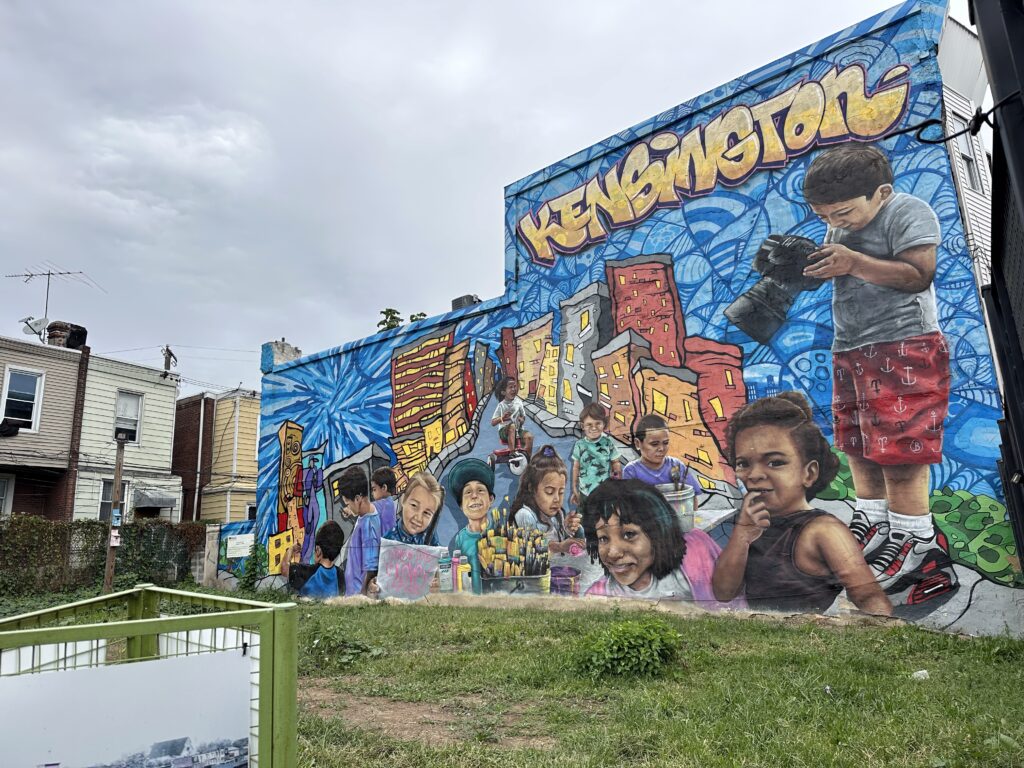
A community garden and gathering space stewarded by KCT, created through the assembly of multple vacant lots.
The Community Justice Land Trust (CJLT) is a program of the Women’s Community Revitalization Project, a women-led charity operating as community developer, land trust, housing operator, advocacy organization, and more. Establishes in the early 2000s, CJLT’S mixed-tenure portfolio includes rental and homeownership options, much of which has been built on vacant public land acquired from the Philadelphia Land Bank. CJLT stewards its own Acquisition and Development Loan Fund, attracting private investments to enable the land trust to act quickly on acquisition opportunities and kickstart early development activities.

Thirty-five new built rent-to-own townhomes owned by CJLT.
Defeating a stadium proposal in Chinatown
The Save Chinatown Coalition exemplifies grassroots power in resisting speculative mega-developments. Formed in response to a proposed $1.3 billion arena near Chinatown, approved by council through a controversial $50M community benefits agreement, the coalition united residents, cultural groups, and advocacy organizations to defeat the stadium project in January 2025. While the proposal was withdrawn, project proponents continue to purchase area real estate, and organizers remain vigilant.

Thousands of people have organized against the proposed arena (photo by Heather Chin/Billy Penn)
Though not explicitly featured within conference programming, it is worth noting the success of the Neighborhood Gardens Trust (NGT) in stewarding urban agriculture space for community benefit since 1983. NGT works with self-organized gardeners, community organizations, property owners, and the City of Philadelphia to preserve and protect community agriculture and open spaces.
Exploring Similarities and Differences
Canada’s community land trust movement mirrors many aspects of the work in Philadelphia:
- Displacement as a catalyst for organizing: In both Canada and the Philly, CLTs are most often mobilized in neighbourhoods under threat of development-induced displacement—from Chinatowns to Black communities.
- Creative legal structures: The combination of trusts and nonprofits signals a growing sophistication in community ownership mechanisms. There are clear parallels between Kensington Corridors’s “neighborhood trust” model and emerging initiatives in Québec that pair social utility trusts with nonprofits (see Ecoquartier Louvain and Territories Solidaires).
- Community-based financing: On both sides of the border, community-based investment fills financing gaps. Tools such as community bonds are enabling quick acquisition of real estate by CLTs (see campaigns by Ottawa CLT and Toronto’s Kensington Market CLT).
Though standout features of Philly’s community land ownership ecosystem, the following remain underexplored in the Canadian movement:
- Public lands banks: One of the major enablers of Philadelphia’s community ownership ecosystem is close ties to the Philadelphia Land Bank. With Canada Lands for Homes, a federal initiative to unlock surplus public land for affordable housing, a major window is open for Canada’s CLT to acquire public lands while also advocating for similar opportunities at the provincial and local levels.
- Restorative and solidarity economies: Both KCT and CJLT explicitly frame their work within broader movements for restorative economics and solidarity economies, moving beyond the limited notion of CLTs as merely “nonprofit landlords”. In Canada, while these values often guide CLT work internally, they are less commonly reflected in public narratives or policy frameworks. Thankfully, emerging research is helping to demonstrate how CLTs can “contribute to the equitable transformation of the housing system”.
Continuing Cross-Border Learning
This is one of several times CNCLT has ventured south of the border to learn from the US movement for community land ownership (see 2024 Liberated land Trust tour and 2025 Grounded Solutions Conference). Each time has proven to be deeply informative, with concrete lessons and provocative questions poised back to the Canadian CLT movement.
We extend our thank you again to the Next City team for accepting CNCLT director Nat Pace into this year’s cohort and look forward to following up with connections made.
Moving forward, CNCLT remains open and excited by international collaboration, knowledge sharing, and coalition-building. We enthusiastically invite those involved with the movement for community land ownership to get in touch to work together and amplify our collective efforts.